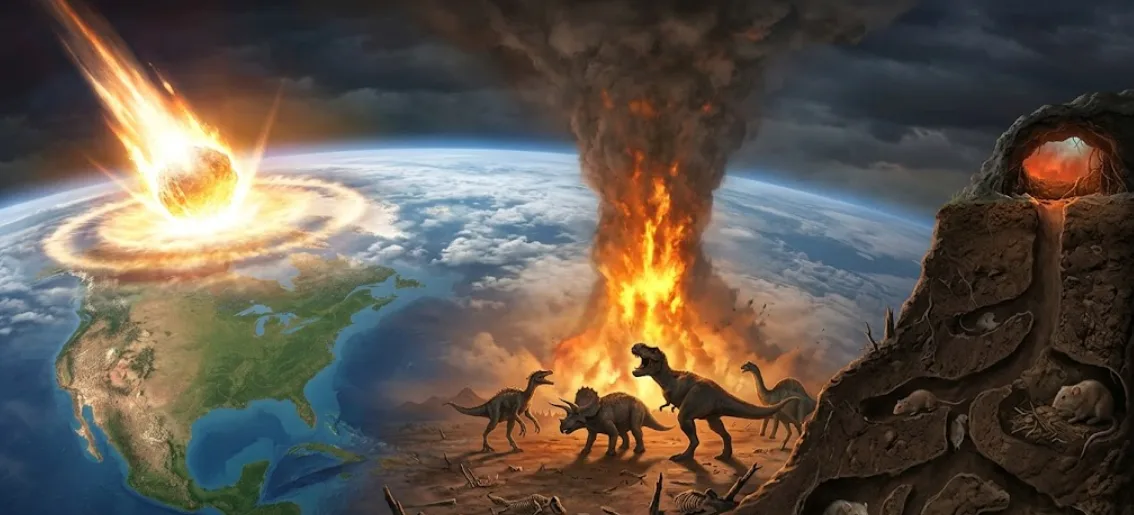
Sixty-six million years ago, it was just another ordinary day on prehistoric Earth. Dinosaurs were roaming around, entirely unaware that a massive 10-kilometer-wide asteroid was hurtling toward them at a blistering speed of 64,000 kilometers per hour.
What followed in the next few hours didn't just end their reign—it completely reshaped the future of our planet.
An Unimaginable Impact
When that colossal space rock finally struck the Earth, the collision was almost beyond human comprehension. To put it into perspective, the impact was roughly a billion times more powerful than the atomic bomb dropped on Hiroshima.
The sheer force of the crash was so immense that massive chunks of Earth were blasted straight out of our atmosphere. According to some scientists, debris was thrown so high into space that it may have actually reached the Moon.
A Sky Raining Molten Rock
If the initial blast wasn't enough, what came next was truly terrifying. Within just 40 minutes of the impact, those huge pieces of debris that were launched into space started falling back down. As they re-entered the atmosphere, they turned into a fiery rain of molten rock.
The friction from all this falling debris caused the atmosphere to superheat. The air temperature spiked to a blistering 1,500°C (around 2,700°F). For the dinosaurs living on the exact opposite side of the planet, there was no warning. They had no idea what had just happened; suddenly, the air simply became too hot to survive.
Two Years of Darkness
The immediate aftermath was devastating, but the long-term effects were what truly sealed the fate of the dinosaurs. The impact kicked up colossal clouds of dust, sulfur, and ash that blanketed the entire globe. This thick, toxic layer blocked out the sunlight completely, plunging the Earth into a dark, freezing winter that lasted for two solid years.
Without sunlight, plants couldn't grow, the food chain completely collapsed, and approximately 75% of all living species on Earth were wiped out.
The Unlikely Survivors
Despite the apocalyptic conditions, life found a way to hold on. While the mighty dinosaurs perished, some creatures managed to survive the freezing darkness. Who were these resilient survivors? They were tiny, rat-sized mammals that lived in underground burrows, completely shielded from the worst of the heat and the cold.
These small, unassuming creatures outlived the dinosaurs. Fast forward 66 million years, and the descendants of those tiny mammals evolved, grew, and eventually became us.
It’s a fascinating twist of fate: from hiding in burrows just to survive, humanity has now advanced to the point where we are designing spacecraft and planetary defense systems to ensure an asteroid like that never catches us off guard again.