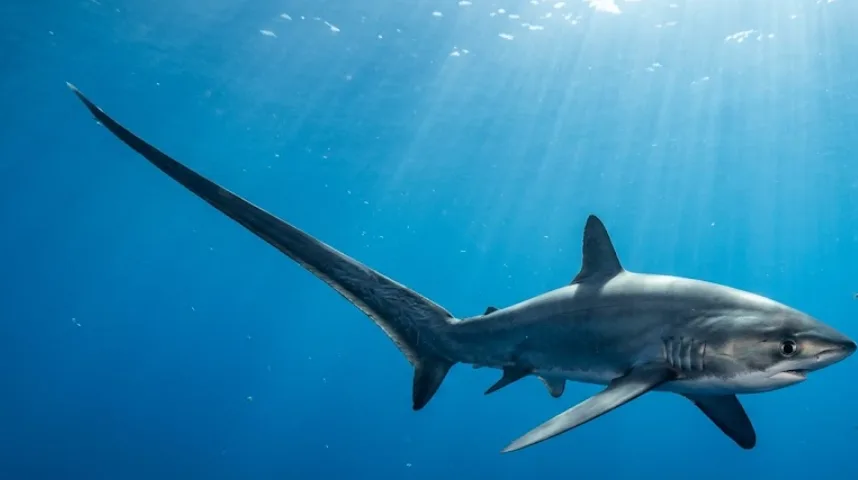
If nature held a workshop for designing the most improbable, brilliant hunting tool, the Thresher Shark (family Alopiidae) would be its star pupil. Forget the massive jaws of a Great White or the brute force of a Tiger Shark; the Thresher has developed an aquatic weapon so specialized and dramatic that it looks like science fiction. Its entire existence is built around a single, astonishing feature: a tail that acts like a bullwhip.
The Weapon: Evolution Gone Wild
The defining feature of a thresher shark is its upper caudal (tail) fin, which is not just long; it’s ridiculously long, often exceeding the total length of the rest of its body. This isn’t for balance or just extra speed. It’s a weapon. When a thresher finds a tight school of small fish (a "bait ball"), it doesn't just bite them. Instead, it engages in what scientists call a "scorpion strike." The shark charges and, with a powerful, specialized lateral whip-slap of its tail, generates an immense shockwave that can travel over 50 miles per hour, stunning multiple fish at once. It can even snap so fast that it creates momentary cavitation bubbles—literally boiling the water for a millisecond before the stunned prey can even react. It then turns around and feeds on its paralyzed lunch. This tactical use of a body part for offense is virtually unique in the shark world.
The Special Rete Mirabile: Why They Are Deep-Sea Ninjas
While most sharks are cold-blooded, threshers have evolved a complex network of counter-current heat exchange blood vessels called the rete mirabile ("wonderful net"). This acts as a biological heater, allowing them to keep their internal body temperature significantly warmer than the surrounding water. This advantage is crucial because it gives their muscles, brain, and—most importantly—their massive eyes a metabolic boost. This "warm-bloodedness" lets them move faster, think quicker, and see more clearly in the freezing, pitch-black deep sea, where other predators cannot survive or hunt as effectively.
Not Just One Shark: The Thresher Trio
When you talk about a thresher shark, you're actually referring to one of three distinct species, each adapted to a unique open-ocean lifestyle:
-
The Common Thresher (Alopias vulpinus): The biggest and most well-known. A true ocean wanderer, found globally in both temperate and tropical waters, with a powerful, classic silhouette.
-
The Pelagic Thresher (Alopias pelagicus): The elegant specialist. Slightly smaller and found primarily in the open Pacific and Indian Oceans, this sleek species prefers the deep twilight zone. It is famous in the scuba diving world because it visits shallow "cleaning stations" (like at Malapascua in the Philippines) at dawn to have parasites cleaned from its skin.
-
The Bigeye Thresher (Alopias superciliosus): The weirdest of the bunch. They look perpetually surprised, with gigantic, upward-pointing eyes that dominate their heads. They also have a unique groove on their skull that looks like a protective helmet. These modifications are specifically for living in the extreme deep, twilight zones during the day, using their eyes to spot silhouettes above them.
Where Do They Live (And How Do We Know They Exist)?
Threshers are pelagic, which means they spend their entire lives in the vast, open ocean, far from the coastline or reefs that host most other sharks. They are found worldwide in all temperate and tropical oceans. Because they live in such a colossal, three-dimensional habitat and are highly elusive, they were incredibly difficult to study until the era of satellite tagging. Now, we know they are among the most adventurous divers, with the Bigeye species recorded descending over 1,600 feet to hunt, rising to surface waters only at night to follow migrating fish.
Conservation: The Whip in Peril
Now we must talk about the difficult reality. The very specialized life history that makes the thresher so incredible also makes it exceptionally vulnerable. All three thresher species are now listed as either Vulnerable or Endangered by the IUCN.
There are two primary reasons:
-
Bycatch: Their unique hunting method—whipping their tails into a bait school—means they are frequently snagged by the tail on commercial longline fishing gear (which can be miles long and carry thousands of hooks) intended for tuna and swordfish. They essentially hook themselves by trying to use their weapon.
-
Low Reproductive Output: Nature didn’t design them to reproduce quickly. Females don't hit maturity for many years and give birth to only 2 to 4 pups after a long gestation. A single population can be decimated by a few years of heavy fishing pressure, and it takes decades to recover. Their populations are in drastic decline, and their spectacular whip is at risk of falling silent in our lifetime.